


First, separate the model from the workflow
As of October 17, 2026, GPT-6 Astra is listed in OpenAI’s official model documentation, including an API model identifier and descriptions of its capabilities. That does not mean Astra is built into Shopify or connected to OCTOshopX. The workflow in this article is a planning concept, not a released integration or a claim that OCTOshopX has been tested with Astra. [1] [2]
Shopify documents Sidekick as an admin assistant that can create product descriptions, blog posts, and images, with changes presented for review. Merchants should distinguish this available Shopify capability from the hypothetical workflow below. [3]
- Use real catalog data and approved brand guidance as the source of truth.
- Treat model-generated material as a draft for a person to verify, never as proof of product details.
Turn verified product facts into a useful brief
Imagine a small ceramics shop preparing a new stoneware mug. The merchant gathers capacity, dimensions, material, care instructions, color options, shipping details, and the actual product photos. A hypothetical model-assisted brief could organize these facts into a concise checklist and flag missing details before any copy is written.
The important discipline is to separate supplied facts from suggested phrasing. If the catalog says the mug is 350 milliliters, a draft may state that measurement; it should not invent that the mug is dishwasher-safe, handmade locally, or made from a particular clay unless the merchant has confirmed it.
- Mark unknowns as questions for the merchant rather than filling them with guesses.
- Keep variant-specific information attached to the correct size, finish, or color.
Build batches small enough to review
For a collection launch, a future Product & Blog Studio concept might prepare a batch of one to ten products at a time. A merchant selling candles, for example, could review each scent’s description and product facts together, then compare tone across the collection without losing sight of individual differences.
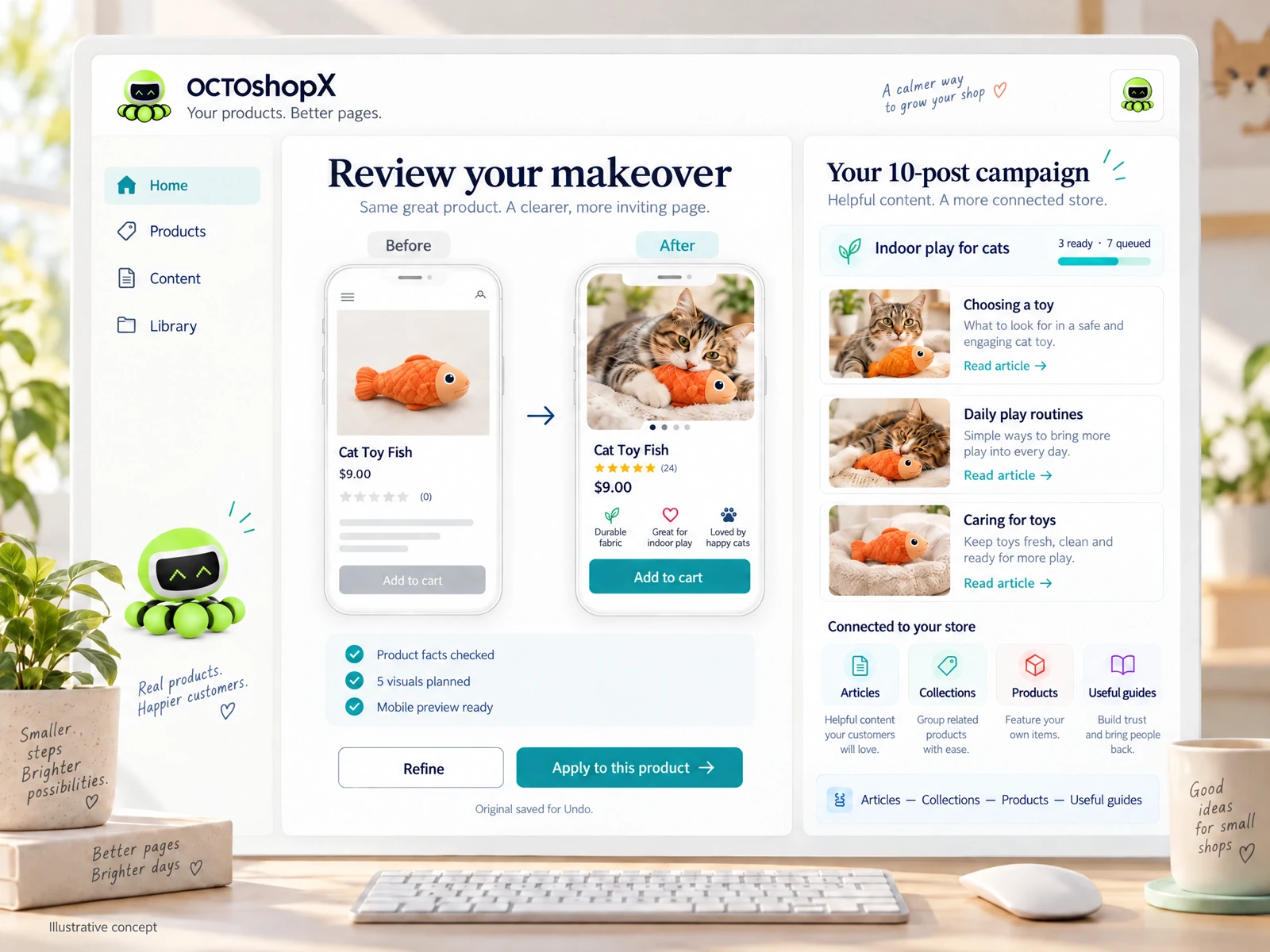
A batch is useful only if review remains manageable. The OCTOshopX plan calls for review before applying changes and Undo; these are planned product capabilities, not features merchants can use today. Until an installer and checkout are available, treat them as a product direction rather than a live workflow.
- Start with a few representative items and correct the brief before expanding the batch.
- Check titles, variants, claims, and calls to action for every product before publishing.
Plan visuals around the product, not novelty
A useful imagery plan is more than a pile of decorative generations. For the mug, a merchant might need a clean primary image, a scale reference beside a hand, a close-up of the glaze, and a kitchen context scene. The OCTOshopX concept envisions five to ten useful visuals and a mobile preview, but neither capability is released or independently benchmarked.
Real product photos should anchor the process. Generated or edited scenes need a careful check for altered handles, inaccurate colors, impossible proportions, and misleading use. Shopify describes Sidekick as able to help upgrade phone photos, but that is Shopify’s stated capability and does not validate a separate OCTOplux product. [4]
- Keep at least one faithful image that clearly represents the item customers will receive.
- Review crops and legibility on a phone-sized preview before using an image.
Read the connected-content guide or explore product and blog specimens.
Connect articles to products with editorial judgment
A helpful article can answer a genuine customer question and point to relevant merchandise without reading like a catalogue. For a tea shop, a guide to choosing a brewing temperature might link readers to suitable teas and accessories, while clearly explaining that product recommendations are the shop’s own selection.
OCTOshopX’s planned content direction includes up to ten posts per campaign and a Shop the Post relationship across Articles, Collections, Products, and Useful guides. This describes a roadmap concept, not a functioning publishing feature. Shopify Sidekick, by contrast, is documented as able to create blog content within its Shopify admin experience. [3]
- Answer the reader’s question before inserting product links.
- Check that every linked item is in stock, relevant, and correctly represented.
Use a human publish gate and budget honestly
A sensible future workflow ends with a merchant checking factual accuracy, accessibility, mobile presentation, SEO fields, links, and brand voice before applying or publishing anything. Keep a record of what changed so that a correction is straightforward. No model should be allowed to silently publish unreviewed claims merely because it can produce fluent copy.
OCTOshopX is planned as a Shopify Product & Blog Studio, not a proven or currently installable service. Its reference MSRP is $599 for one store or $997 for up to ten stores, including one year of updates and support; optional renewal is $79 or $149 annually. AI plans and selected image or API services cost separately. Any temporary sale is a limited cash offer, not perpetual free AI. These figures describe the stated reference pricing, not proof of current availability. OCTOshoutX is also upcoming only, with a planned 9:16 UGC/product-video and 48 kHz audio direction, potentially using a merchant’s own hardware and budget; that does not guarantee virality or zero total cost.
- Do not assume a particular model, API, image service, or video feature is included in a product price.
- Confirm availability, terms, and service costs before committing budget.
Is GPT-6 Astra a confirmed OpenAI model?
Yes. As of October 17, 2026, OpenAI’s official model documentation lists GPT-6 Astra and the API identifier gpt-6-astra. That confirms the model in OpenAI’s documentation; it does not establish any OCTOshopX integration. [1] [2]
Can I install OCTOshopX and use this workflow now?
No installer or checkout is currently available. OCTOshopX is a planned Product & Blog Studio concept, and the workflow described here should not be read as a released, proven, or benchmarked integration.
Does OCTOshopX pricing include unlimited AI, images, or video?
No. The reference MSRP includes one year of updates and support, while AI plans and chosen image/API services cost separately. OCTOshoutX is upcoming only, and no claim of guaranteed virality or zero total cost is warranted.
Sources & comparison notes
Provider-described features and prices can change. Check the linked sources and purchase terms before choosing a service.
- Models — OpenAI API documentation · checked 2026-10-17
- GPT-6 Astra: A new generation of intelligence — OpenAI · checked 2026-10-17
- Sidekick — Shopify Help Center · checked 2026-10-17
- Shopify Magic — Shopify · checked 2026-10-17
Install OCTOshopX. Give your store one clear job.
GPT-6 Astra can be discussed as an officially documented model, but a Shopify workflow that uses it through OCTOshopX remains a clearly labeled future concept. Merchants can apply the underlying habits now: work from verified product facts, keep creative drafts grounded in real imagery, review every change, and budget separately for external AI services. OCTOshopX’s planned features should not be mistaken for an available Shopify app. Install OCTOshopX.
A calm Shopify Product & Blog Studio: 5–10 useful visuals, connected articles and products, preview before publishing, and 1-Click Undo when needed.