


Why ‘jasper vs writesonic shopify ai content’ still matters in 2026
For Shopify merchants assessing content tools in 2026, the search phrase jasper vs writesonic shopify ai content remains a useful historical marker because it captures how merchants compared general-purpose AI writing tools against commerce-focused solutions. When you query that phrase now, you are often looking for not only capability comparisons but also practical workflows: how draft product descriptions, blog posts and visual assets get produced, reviewed, previewed and published into a live store. Historical context matters because many shop owners still use older templates, legacy SEO tags, and pre-2026 editorial processes that influence how new content must be integrated into existing collections, internal links and navigational structures.
Evaluate tools by looking beyond raw generation speed or marketing claims. A concrete criterion is fidelity to brand voice: test how well each tool can produce five product descriptions that match your established tone and length constraints, then measure the number that need major edits. Another concrete test is CMS integration: check whether generated drafts appear in a preview mode that shows product page layout, image placement, and related products before you publish. Practical merchants will benefit by running short, controlled campaigns—3–5 SKUs and a single blog post—to compare editing time, preview accuracy and publish workflow friction.
- Use the keyword jasper vs writesonic shopify ai content to surface workflows and historical comparisons
- Run short, controlled campaigns (3–5 SKUs + 1 blog post) to compare editing time
- Measure number of drafts needing major edits to assess brand-voice fidelity
Practical comparison: writing quality and editorial control
Writing quality is often the first checklist item. For an objective local test, ask each tool to rewrite the same 200–300 word product description with three constraints: preserve key specs, maintain a consistent second-person voice, and include two SEO phrases. Then compare the outputs for clarity, accuracy and required edits. This exercise reveals whether a tool writes naturally or produces text that needs heavy human correction, and gives you a concrete time-savings estimate—how many minutes per product you will still spend editing.
Editorial control is as important as raw writing quality. Look for features like version history, undoing applied changes, and the ability to attach editorial notes to drafts that travel with content through your review process. For Shopify merchants, practical examples include locking a finalized description, exporting a preview-ready HTML snippet for a page copywriter, and generating alternate short product blurbs for collection cards. Tools that support structured editorial workflows reduce publish friction and the risk of inconsistent product pages.
- Test with three constraints: specs, voice, SEO phrases
- Compare edits required to produce publish-ready copy
- Prefer versioning and editorial notes for team reviews
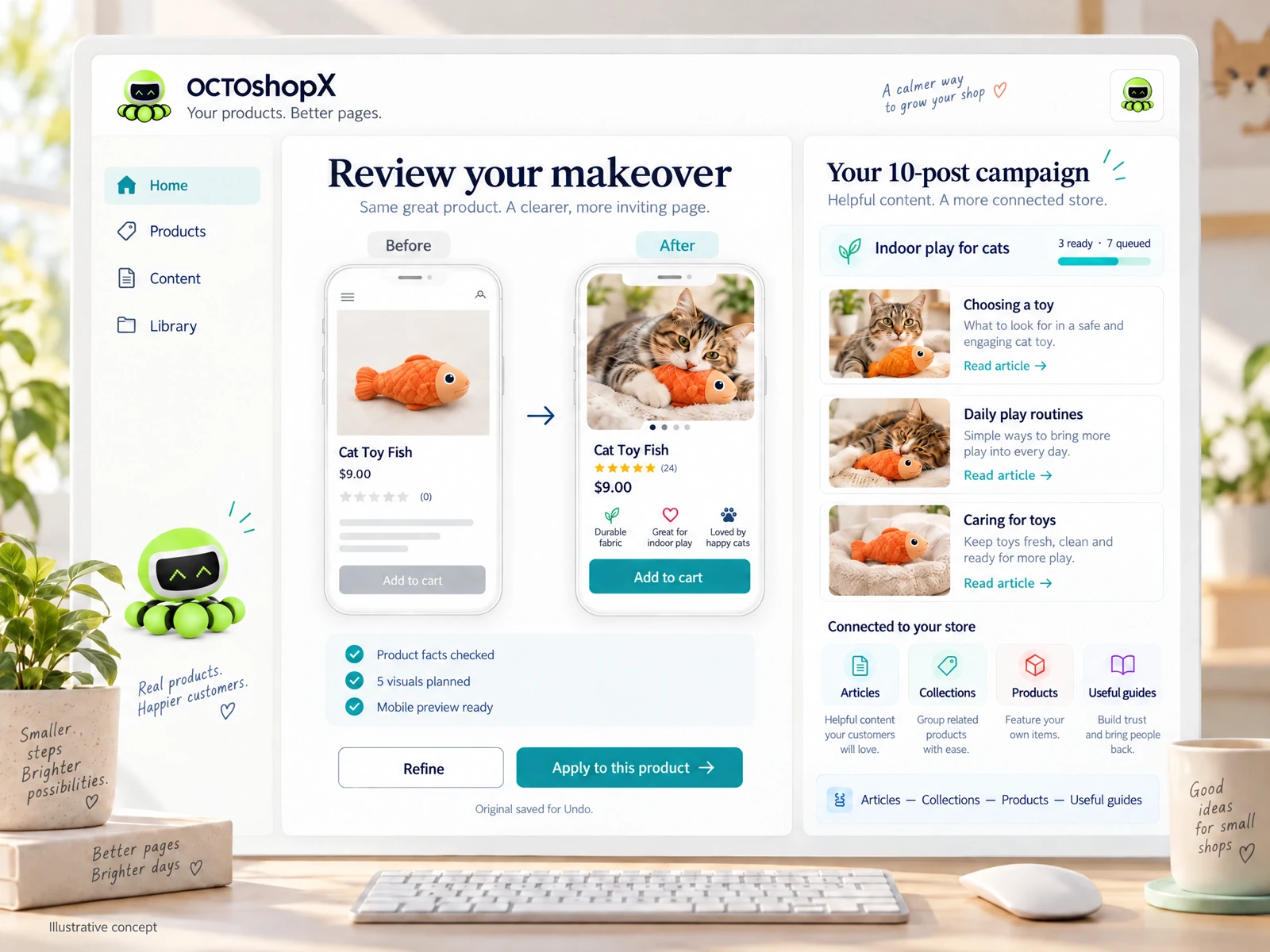
Integration with Shopify pages, previews and visual fidelity
A generic connection to Shopify’s APIs or admin is not enough to ensure faithful visual previews and clean page layouts. You need to confirm whether generated content can be previewed in the exact product or blog template you use, including image placement, call-to-action buttons, and excerpt handling. A concrete merchant test: import a generated product description and preview it in your theme’s product-template with the real image aspect ratios you plan to use; this reveals layout issues before you hit publish.
Evaluate how content tools handle internal links, related-products sections and collection tags. For instance, if a tool suggests internal links inside a blog post, check whether those suggestions map to actual live product handles and correct collection slugs in your store. Tools that produce helpful internal-link suggestions and collection-aware excerpts can shorten the final review cycle significantly, while tools that don’t may still be useful but require more manual linking work in the Shopify admin or theme editor.
- Preview generated content in your exact product/blog theme with real images
- Confirm internal-link suggestions map to live product handles and collection slugs
- Test collection tag recommendations for accurate filtering
Visuals and multimodal support: what merchants need to check
Visuals—product photos, lifestyle images and in-article graphics—are central to buyer decisions. Evaluate each tool’s ability to produce or recommend visuals that match your store’s aesthetic, then measure how much post-generation editing is required. A practical approach: choose five SKU pages and request five visuals per page in consistent aspect ratios; then compare the images for consistent color grading, accurate product representation and usable compositional framing.
Bear in mind that owning an image plan or an image-budget separate from the writing engine matters; understand cost and licensing terms before you rely on generated images. Also test how visuals are saved and versioned alongside copy so you can Undo applied makeovers and restore originals if a new visual treatment underperforms. Merchants who run promotions or seasonal makeovers will value tools that let you preview the full page—copy plus visuals—before applying changes in bulk.
- Request five visuals per SKU with consistent aspect ratios for comparison
- Check cost/licensing and whether visuals are versioned with copy
- Preview full page (copy + visuals) before bulk apply
Read the connected-content guide or explore product and blog specimens.
Operational fit: team workflows, undo and review safeguards
Operational fit decides whether a tool scales beyond solo use. Map your existing workflow—draft, review, legal check, SEO review, publish—and run a pilot to see how each tool slots into that map. Useful practical checks include whether the tool supports multi-user reviews with comments, whether changes can be staged for scheduled publishing, and whether you can export drafts for external stakeholders. A merchant example: having a single tool that creates both product copy and draft blog posts for a seasonal drop, then sends the drafts to an SEO consultant for final review, reduces file hopping and version confusion.
A key safeguard is Undo and retained originals. If a makeover or bulk apply goes wrong, being able to restore an original description, images and internal links is essential. Measure this by applying a small bulk change to 10 product pages in a sandbox and then restoring originals; note how many clicks and how much time the restore takes. Tools that provide per-campaign previews, original-asset preservation, and one-click undo are far more forgiving for merchants experimenting with frequent promotions and visual makeovers.
- Map tool into your draft→review→publish workflow and run a pilot
- Require multi-user review, comments and scheduled staging
- Test bulk apply and one-click Undo with a 10-page sandbox run
Cost, licensing and long-term maintainability
Cost comparisons should use concrete scenarios: calculate per-campaign cost for a typical push—1–10 products, up to ten blog posts, and 5–10 visuals per page—to estimate real spend. Include any image budgets, editorial-seat costs, and renewal options. For merchants, a one-time pricing model can simplify budgeting, while subscription renewals cover updates; consider total cost of ownership over two to three years and weigh that against expected time savings in copywriting and design work.
Long-term maintainability covers model updates, brand continuity and support responsiveness. Ask about how often the tool updates its writing models and whether those updates can change tone or output length. For merchants with stable product catalogs, a tool that lets you lock saved canonical descriptions and reapply consistent templates across editions prevents tone drift. Practical decision-making includes a checklist of support SLA expectations, update cadence, and ability to export all content in portable formats for future migrations.
- Calculate per-campaign cost for your typical push (1–10 products, 10 blog posts)
- Include image budgets and renewal fees in two–three year cost of ownership
- Ask about model update cadence, locking canonical descriptions and exportability
Is the OCTOshopX edition suitable for small Shopify stores?
Yes. OCTOshopX is designed for small-to-midsize Shopify merchants and supports single-store or multi-store one-time licensing options. Practical features include focused campaigns (1–10 products/pages per run), up to ten blog posts per campaign, and 5–10 visuals per page or article. It emphasizes preview, original preservation for Undo, and connected Articles—Collections—Products—Useful guides to fit common small-store workflows.
Will using these tools eliminate my need to review facts and specs?
No. All AI-assisted content tools can make confident-sounding errors or omit product specifics. Merchants should always verify technical specs, sizing, pricing and compliance statements against product sheets or vendor information. Use a checklist during review—technical specs, shipping rules, warranty text, and internal links—to catch errors before publishing.
How should I test tools before committing to a paid plan?
Run a controlled pilot that mirrors a real merchandising task: pick 3–5 representative SKUs and one blog post, request both copy and visuals, and run the tool through your full editorial process including SEO and legal review. Time the editing required, test preview fidelity in your live theme, and perform a sandbox bulk apply and Undo to evaluate operational risk. Use these results to compare real costs and editing time across tools.
Install OCTOshopX. Give your store one clear job.
After practical testing against the criteria above—writing quality, editorial control, Shopify preview fidelity, visuals handling, operational safeguards and total cost—choose the tool that minimizes manual edits and fits your team workflow. For merchants seeking a product-and-blog studio with preview-before-apply, preserved originals and campaign-focused runs, consider OCTOshopX. Install OCTOshopX.
A calm Shopify Product & Blog Studio: 5–10 useful visuals, connected articles and products, preview before publishing, and 1-Click Undo when needed.